Showing posts with label engineering is elementary. Show all posts

Tuesday, July 15, 2014

Engineering on a shoestring


 In my last entry I described the joy of using the Lego Wedo and Mindstorms sets to teach elementary school engineering skills as defined in the Next Generation Science and Engineering Standards .


However, you don't need to go to the expense of purchasing the Lego kits to teach perfectly good elementary school engineering skills.


 By way of introducing the concept of engineering in the elementary school we first distinguished it from science. This can be most easily done by looking at the origin of the questions or curiosities one might have when studying a situation.


 In science the questions or inquiry arise from the natural world;  how are rocks forms, what causes the seasons, what affects the time of a pendulum swing, how is  paper made?


 In engineering the questions or inquiry arise from how we use our scientific knowledge and understanding to solve problems, resolve issues or make life better.


 This implies that the study of science comes first. We can then use our new-found knowledge and understanding and make it more relevant and meaningful by applying it to an engineering situation.


 During GED695 we studied the science of a swinging pendulum and then used this knowledge to design a pendulum that swung once every second. Since all good engineering solutions need to be presented each group of students timed their pendulum to see who had made the most accurate one.


The prize went to Theresa and Monique; their pendulum swung precisely 30 times in 30 seconds exactly. 


 We also used a copy of the Sunday Free Press (free the following Monday) to construct the tallest towers we could that supported a small washer.

 Trisha,
 Kate,

Ashley and Julie built an incredibly elegant one from floor to ceiling.


 Everyone, however, was successful in building a tower and realizing a great sense of achievement.


The capital outlay for these two engineering classes? $0

Wednesday, May 8, 2013

A Different Kind of Final Exam

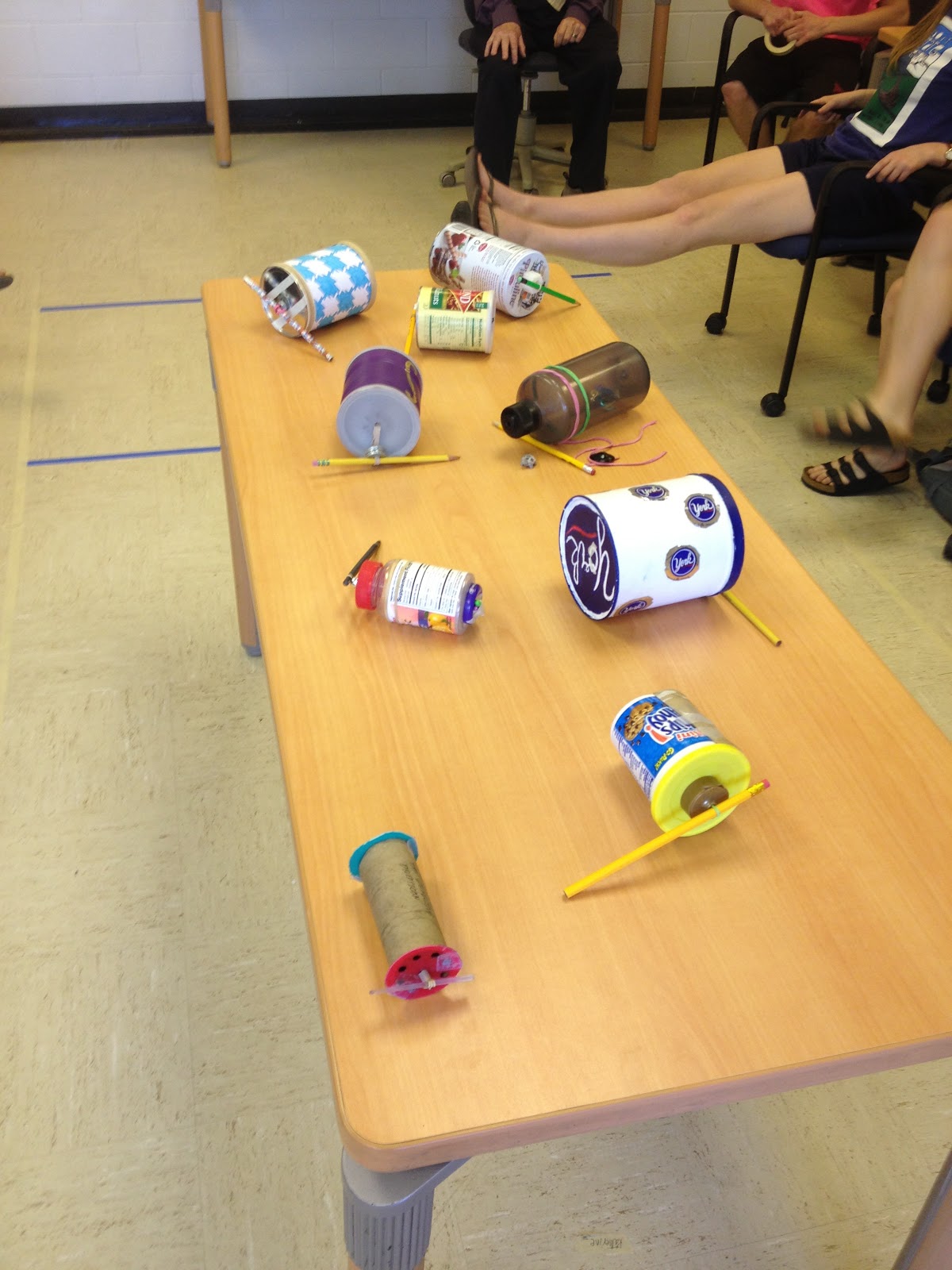
At the end of my Teaching Elementary School Math and Science course students are required to solve an engineering problem for the final exam. The problem comprises the construction of a Rubber Band Roller (RBR), a vehicle powered by a rubber band. In essence the RBR consists of a cylinder of some sort, a rubber band and a stick such as a pencil. But in reality it is so much more as the students always find out. The definition of a good problem in any academic field is a situation that cannot be immediately resolved without the application of knowledge and thought. For example if you know that 3 x 4 = 12 then you don't have a problem.

If we define science as the exploration of questions in the natural world then we can define engineering as the use of science to solve problems in the world in general. The RBR is such a great engineering project because it never, ever works first time. As Aris, one of my students wrote, "Overall, my emotions with this project went from excited, to frustrated, to more frustrated, to feeling hopeless, to then suddenly having the wonderful feeling of accomplishment".  The project requires the students to use all the engineering process skills we discuss in class. These are; defining a problem, researching relevant information, designing, constructing, testing, adapting and improving, and completing and presenting. 

The 'presenting' part is what constitutes the final exam where students can enter their RBR in 3 competitions; distance, speed and creativity. Congratulations to Leanna who broke the world distance record with four times up and down the length of the classroom (about 60 feet), and to Jenn who won the speed trial with .6 seconds over three feet, and to Emily who decorated her RBR with a Peppermint Pattie motif. The winners each received a copy of an  elementary school science activity resource book but all participants were winners because they all overcame what really is quite a difficult engineering problem.